

You hit a heater. The reels line up, your blackjack strategy holds, and suddenly you’re ahead by a figure that makes your hands shake. Then the email lands: “Account under review.” Or worse, “We’ve closed your account.” If you’ve ever wondered whether Canadian casinos can ban you simply for winning, you’re not alone. The short version: it’s rarely about the win itself. It’s about how you won, or what that win signals to a compliance team operating under strict rules.
Let’s cut through the folklore and look at what really happens in Canada—online and on the casino floor—why accounts get restricted, and how to keep playing without unnecessary drama. 🍁



Short Answer: Do Casinos in Canada Ban People for Winning?
Not for a legitimate win alone. Casinos, whether land-based or online, make money by offering games with a house edge. They’re built to pay winners. But they also have both the legal right and the regulatory obligation to stop activity that threatens game integrity, violates terms, or raises money-laundering flags. That can look, to a frustrated player, like being “banned for winning.”
In practice, big wins often trigger verification, bet limits, or temporary holds while the operator checks for compliance issues. It’s the process—not the payout—that creates the friction.
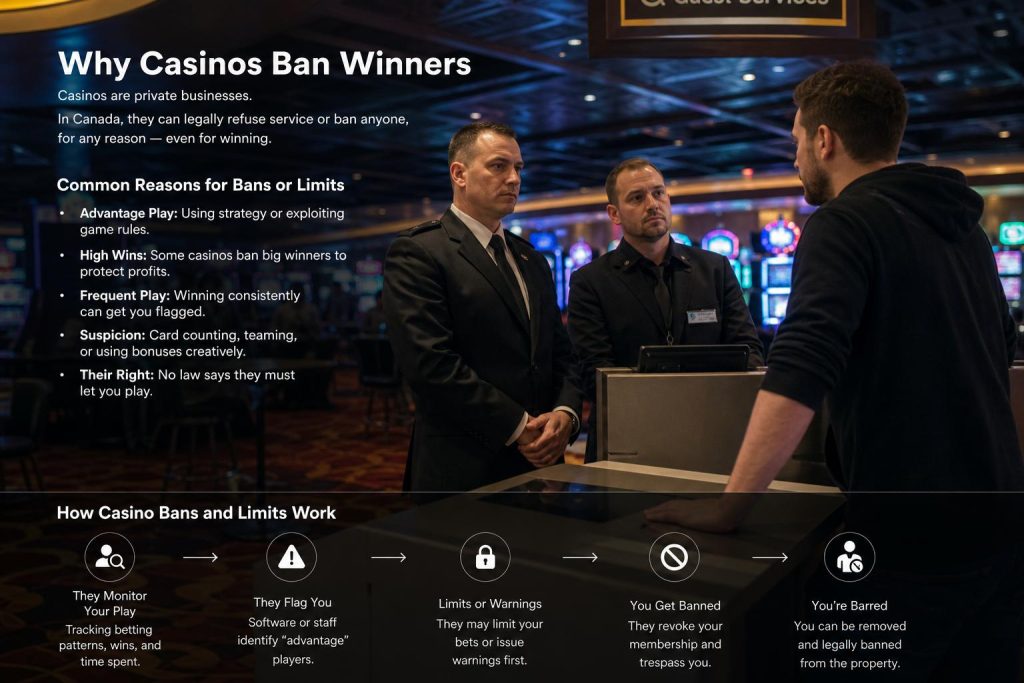
How Casino Bans and Limits Actually Work
Land-Based Casinos in Canada
Physical casinos are typically operated under provincial oversight (think Ontario, British Columbia, Quebec, Alberta, etc.). They’re private premises with the ability to refuse service—so long as they don’t violate human-rights laws (e.g., discrimination on protected grounds). If surveillance thinks you’re using prohibited devices, colluding at poker, or advantage-playing in a way they consider unacceptable (e.g., hole-carding), they can back you off a game, limit your action, or trespass you.
Card counting, for example, is legal. But casinos aren’t obliged to offer you blackjack if they believe your skill threatens their risk profile. They can reshuffle early, limit your bet spread, change table rules, or ask you to move along.
Online Casinos Serving Canadian Players
Online, the mechanics are different but the logic is the same: operators manage risk and follow rules. They can restrict bet sizes, void bonuses, or close accounts if they suspect violations such as multiple accounts, bonus abuse, bots, or location masking (VPNs). They also have strict anti-money-laundering (AML) and “know your customer” (KYC) obligations. Sudden large wins often mean proof-of-identity checks or source-of-funds questions before payouts are released.
None of that equals “you won, therefore you’re banned.” It’s “you won, therefore we must verify.” Annoying? Sure. But standard.
The Law and Your Rights in Canada
Here’s the framework that shapes what operators can do:
- Provincial regulation: Each province oversees its land-based casinos and, in some cases, online platforms. Ontario, for instance, has a regulated private-operator market under the Alcohol and Gaming Commission of Ontario (AGCO) and iGaming Ontario.
- Private property and terms: Casinos can refuse service or close accounts subject to their house rules and the law. They can’t discriminate on protected grounds, but they can act for risk control, integrity, or compliance reasons.
- AML and KYC: Casinos must verify identities, monitor transactions, and sometimes ask for documentation about where funds came from. These checks are mandated; they’re not optional courtesy calls.
- Dispute pathways: Regulated sites must provide complaint processes and, in some markets, access to an independent dispute resolution body. Offshore sites often name an ADR in their terms. Outcomes vary, but you’re not without recourse.
The key: your agreement with an online casino is governed by its Terms and Conditions. Most give the operator power to limit or close accounts for fair play violations, bonus misuse, or compliance failures, even if you’ve been winning.
Common Triggers That Get “Winners” Restricted

A hot streak by itself usually doesn’t cause a ban. But certain patterns tied to winnings will. Here are the heavy hitters, online and off.
1) Advantage Play at Tables
Some strategies are allowed; others aren’t. Counting cards in blackjack is legal but unwelcome. Hole-carding, device assistance, or using hidden electronics is prohibited. Casinos can protect themselves with rules, shuffles, and—if they decide it’s necessary—exclusion.
- Card counting: Expect heat, reduced bet limits, or an invitation to leave the table.
- Edge sorting or marked cards: Considered cheating; this can lead to withheld winnings and a ban.
- Suspicious team play: Especially at blackjack or baccarat, coordinated betting can draw a quick response.
2) Bonus Abuse and “Irregular Play” Online
Operators design bonuses for recreational play. If your pattern looks like you’re sandbagging risk to clear a bonus (e.g., hedging bets, “max allowed bet then minimum” loops, abusing insurance mechanics, or playing excluded games during wagering), expect a shut-down. Multiple accounts tied to the same person or household are near-certain closures.
- Example: Using a low-volatility strategy with a tiny edge across multiple welcome bonuses via different email addresses. That’s textbook abuse.
- Result: Bonus confiscation, voided winnings from the bonus, or a permanent ban.
3) KYC/AML and Payment Red Flags
Big wins draw attention. So do mismatched names on cards or crypto wallets, third-party deposits, frequent canceled withdrawals, and chargebacks. Under AML rules, operators may freeze an account until documents are provided. Refuse to comply, and the account likely won’t reopen.
- Mismatched details: Your payout method must match your name and account details.
- Source-of-funds queries: Large or rapid gains may prompt requests for bank statements or employment info.
- Chargebacks: Almost always lead to closure; it’s a major trust breach.
4) Multi-Accounting, Syndicates, and Collusion
Any form of coordinated edge-taking—across poker tables, sportsbook lines, or casino bonuses—is a red flag. Poker collusion or chip dumping is grounds for confiscation and bans. On slots or table games, syndicate-style exploitation of promotions will end the party fast.
5) Prohibited Tools and Software
Bots, auto-clickers, unauthorized scripts, screen-scrapers, or data-harvesting tools violate most T&Cs. Some casinos also restrict specific third-party tools that track outcomes or seek to exploit timing. If your click patterns or API calls look automated, expect trouble.
6) Location and Jurisdiction Issues
Using a VPN to pretend you’re in an eligible province or country is risky. If an operator believes you’re masking your location or breaching local rules, they can void bonuses, withhold winnings gained during masked sessions, or close your account. Location compliance isn’t optional; it’s part of the license reality.
7) Abusive Behavior or Security Concerns
Threats to staff, harassment in chat, doxing attempts, do-not-pay lists, or social engineering at support get instant bans. Security flags—like logging in from multiple far-flung countries within hours—can cause precautionary freezes while they verify the account holder’s safety.
8) Responsible Gambling Interventions
Modern platforms are required to detect risky behavior. If your play shows extreme patterns, you might face cooling-off suggestions or imposed limits. That’s not a “ban for winning,” but if your winning spree is connected to escalating stakes in unsafe ways, the RG team could step in.
What Actually Happens When You Hit a Big Win
A five-figure slot hit or a massive poker score triggers workflow, not panic. Here’s what to expect:
- Verification: You’ll likely be asked for proof of identity, address, and sometimes source-of-funds. Send clean, readable scans; don’t crop details.
- Method matching: Payouts usually go back to the original deposit method first, then the remainder by an agreed route.
- Payment caps and schedules: Some casinos impose daily/weekly payout caps for regular wins. Progressive jackpots are often paid in full according to published rules.
- Cooling-off checks: Sudden big wins may trigger outreach about limits or self-exclusion options (compliance with responsible gambling standards).
It’s not personal. It’s the system working as designed. You want a compliant operator when you win big—it’s the same machinery that ensures you get paid. 🛡️
Common Triggers vs. Typical Operator Actions
| Trigger | Example Behavior | Typical Operator Action | Land-Based or Online? |
|---|---|---|---|
| Advantage Play (tables) | Card counting with large bet spreads | Back-off, table limits, reshuffle, or trespass | Land-Based |
| Cheating/Devices | Electronic aids, hole-carding, marked cards | Confiscation, ban, potential law enforcement | Land-Based |
| Bonus Abuse | Multiple welcome bonuses via multi-accounts | Void bonuses/winnings, account closure | Online |
| Irregular Play | Excluded games during wagering; hedging bets | Forfeit bonus-derived wins, warning or ban | Online |
| KYC/AML Flags | Mismatched names or unexplained large transactions | Account hold pending documents; possible closure | Both |
| Collusion | Coordinated poker play; chip dumping | Confiscation and permanent ban | Online |
| Prohibited Software | Bots, scripts, automation | Ban; potential seizure of illicit profits | Online |
| Location Masking | Using a VPN to evade geo-restrictions | Void affected wins; closure | Online |
| Abusive Conduct | Threats, harassment, chargebacks | Immediate closure | Both |
| Responsible Gambling | Extreme play patterns post-win | Limits or cooling-off; rarely a ban | Online |
How to Protect Your Account and Still Play to Win
Winning shouldn’t come with headaches. Keep these habits and you’ll reduce the odds of a “review” turning into a ban.
1) Pick Reputable Brands and Read the Rules
Choose well-known operators with clear terms and active player support. Many Canadian players use brands such as Bodog, Bovada, Ignition, JackpotCity, Royal Vegas, Spin, Ruby Fortune, BitStarz, Stake, and PlayAmo. Reputable sites publish comprehensive T&Cs, bonus rules, and KYC policies—read them before you deposit.
2) Verify Early
Complete KYC as soon as you sign up. Upload a clear photo ID, proof of address, and, if asked, proof of payment ownership. Make sure your account name matches your bank card, e-wallet, or crypto wallet. This one step can shave days off a big withdrawal.
3) Keep It One Account, One Person
Don’t share accounts. Don’t open a second account to chase another welcome bonus. If your household has multiple players, confirm how the site handles shared IP addresses and payment methods. Multi-accounting is the fastest path to confiscation.
4) Play Bonuses Straight
Bonuses are optional, and they come with strings. If you opt in, follow the letter of the rules: eligible games, max bet during wagering, time limits, and withdrawal conditions. If you’d rather avoid the constraints, play cash-only.
5) Don’t Use a VPN
It’s tempting. Don’t. If the operator detects you used a VPN to bypass geo-blocks, you can lose everything earned under those sessions. Geo-compliance is non-negotiable.
6) Keep Records
Save chat transcripts, deposit receipts, and withdrawal confirmations. If there’s a dispute, a neat paper trail turns a he-said-she-said into a fixable ticket.
7) Be Polite and Patient with Payouts
Big wins take time. Compliance teams aren’t stalling to annoy you—they’re making sure the payout is bulletproof. Stay cordial in support chats. It helps more than you think.
8) Mind Your Banking
Use payment methods in your name. Avoid third-party deposits. If asked for source-of-funds, provide clean statements promptly. Consider leaving a small balance after a large withdrawal to signal ongoing recreational play, not a hit-and-run pattern (some risk teams look at this).
9) Set Limits and Stick to Them
RG tools aren’t just for problem gambling; they’re a sign of healthy play. Deposit limits, time reminders, and cooling-off periods show you’re in control. Operators notice.
Brands Canadians Talk About (and What Their Terms Usually Emphasize)
While every site has its own rulebook, most reputable operators share similar pillars. If you read nothing else, check these sections before you play on platforms like Bodog, Bovada, Ignition, JackpotCity, Royal Vegas, Spin, Ruby Fortune, BitStarz, Stake, PlayAmo, and Royal Panda:
- Account Ownership: One account per person; real name; accurate details.
- Fair Play: No bots, scripts, team play, or exploiting software glitches.
- Bonuses: Eligible games, max bet during wagering, wagering multipliers, time limits, excluded strategies.
- KYC and Withdrawals: Right to request documents and freeze accounts until verification is complete.
- Jurisdiction: Where play is permitted and what happens if you’re outside those areas.
- Operator Discretion: Powers to limit or close accounts for suspected violations.
Reading those sections isn’t fun. But it beats learning the hard way.
Case Studies: When Winning Triggers a Review
Case 1: The Slot Jackpot
You hit a large jackpot at a site like JackpotCity or Royal Vegas. The screen flashes, you celebrate, and within hours you get an email requesting identity documents. After submitting a passport and a utility bill, the operator asks for a brief source-of-funds explanation because the payout is substantial. Once approved, payment flows in installments due to weekly limits stated in the T&Cs. Annoying? A little. Normal? Yes. Paid? Also yes.
Case 2: The Blackjack Counter
In a Canadian land-based casino, you use a disciplined card-counting system with a broad bet spread. Surveillance notices. The pit boss asks you not to play blackjack anymore but says you’re welcome to enjoy other games. That’s a back-off, not a lifetime ban—for now. Keep pressing, and you may be trespassed.
Case 3: The Bonus Grinder
Online, you deposit, claim a hefty bonus, and play a pattern that minimizes variance, bouncing between bets in a way that exactly skirts the rules’ wording but violates the spirit. Risk flags it. A review finds you also opened a “backup” account at the same address. Result: both accounts closed, bonuses void, and winnings from bonus play confiscated.
Case 4: The VPN “Traveler”
You travel, leave your VPN on, and play from a different IP range than usual. Geolocation mismatches trigger a hold. Support requests documents and an explanation. If they conclude you intentionally masked a restricted jurisdiction, they’ll likely void wins from those sessions and close the account. If it was an honest mistake and your location is allowed, they may restore access after verification.
A Word from the Old School
Nick “the Greek” Dandolos famously said, “The casino doesn’t beat the player; it just gives him the opportunity to beat himself.” It’s a reminder that the real edge isn’t always on the felt; it’s in discipline—your choices, your bankroll rules, and how closely you follow the site’s terms.
Disputes and Escalations in Canada
If you believe you’ve been unfairly limited or banned, don’t rage-tweet. Work the process:
- Gather evidence: ID checks you completed, proof of deposits, timestamps, chat logs, screenshots.
- Write a concise summary: What happened, when, and what outcome you want (e.g., release of funds).
- Open a formal ticket: Use the site’s complaint or compliance email, not just live chat.
- Ask for the rule: Request the exact clause the operator says you breached.
- Escalate to ADR or regulator: Many sites list an Alternative Dispute Resolution body. In regulated markets like Ontario, there’s a defined escalation path after the operator’s process is exhausted.
- Be patient but persistent: Follow up weekly with polite, clear messages. Document everything.
This approach wins more cases than angry threads ever will. 💡
FAQ: Quick Answers for Canadian Players
Can a Canadian casino ban me just for winning on slots?
No. Slots are house-edge games; winners happen every day. Big slot wins typically trigger verification, not bans. If your account is clean and documents check out, you should be paid according to the T&Cs.
Is card counting illegal in Canada?
No. But casinos can change rules, limit bets, or refuse service if they believe your skill threatens their risk tolerance. Legal doesn’t mean guaranteed access.
Are bet limits and lowered RTP “punishments” for winners?
Bet limits, yes—risk teams can reduce your max bet. Lowered RTP on regulated online slots isn’t something operators apply to individuals; it’s a setting at the game level. If an operator offers multiple RTP versions, they must disclose the version in use.
Can a casino confiscate my winnings?
They can confiscate winnings tied to clear violations (cheating, prohibited software, bonus abuse, location masking) if the T&Cs permit it and they can prove the breach. Legitimate, compliant wins should be paid.
Will a VPN get me banned?
Using a VPN to bypass location rules often results in voided winnings and account closure. Even accidental VPN use can trigger holds. Best practice: keep it off while playing.
Practical Tips for Slots, Tables, and Online Play
- Slots: Check game contribution to wagering before you accept a bonus. Some high-volatility slots are excluded from bonus play—know which ones.
- Table games: If you’re using strategy tools, confirm they’re allowed. Auto-decision tools can cross a line.
- Live dealer: Don’t pattern-bet in ways specifically barred by bonus terms (e.g., red/black hedging during wagering).
- Poker: Avoid shared devices/locations that might look like collusion. Don’t soft-play friends.
- Sportsbooks attached to casinos: Arbitraging line differences across accounts tied to the same household looks like syndicate activity—expect limits.
Red Flags to Avoid
- Withdrawing right after every big win while declining to verify identity.
- Depositing via one method, withdrawing via another name or unrelated wallet.
- Rushing support with daily threats or chargebacks. That escalates, fast.
- Creating “backup” accounts for new-customer promos.
- VPN-on by default; unknown IPs from distant locations within short time spans.
Green Flags That Keep You Playing
- Consistent identity and payment details.
- KYC completed before your first major win.
- Clear understanding of bonus terms—or skipping them entirely.
- Documented communication with support.
- Responsible gambling tools in place, even modest ones.
Why “Winners” Get Limited: The Business View
Casinos operate on thin, predictable edges. Outlier results—especially when paired with risky patterns—are expensive. Risk teams don’t care if you’re lucky; they care if your pattern suggests they can’t model you. The moment data says “non-recreational,” the response kicks in: lower limits, manual reviews, and sometimes an exit. You can’t control their algorithms, but you can control how clearly compliant your play looks.
If You Want the Smoothest Possible Payout
- Verify in advance and keep your documents current.
- Stick to one account and one identity per brand.
- Use the same name on every payment method you touch.
- Read bonus terms before clicking “accept.”
- Avoid VPNs, auto-clickers, or anything you wouldn’t want explained on a screen-share.
- Withdraw reasonably, accept posted limits, and let payments clear.
The Bottom Line

In Canada, casinos don’t ban people for winning. They ban for what sits behind certain wins: broken rules, risky patterns, or compliance red flags. If you keep your account spotless—verified identity, clean payments, one account, no VPN, and honest play—you stack the deck in your favor when it matters most: the payout.
And when in doubt, remember: playing by the rules isn’t just about being a model customer. It’s the surest way to make sure that “congratulations” screen ends with money in your account, not an email you’ll regret. ✅
More articles on gambling topic